ASME B16.5 Flange Pressure Class Guide: How to Choose Class 150, 300, 600, 900, 1500 or 2500
Published by Angel Metal & Alloys, Ahmedabad | Technical Resource
A plant in Gujarat once specified Class 150 flanges on a 250 psig steam line — because someone calculated that Class 150 rated "up to 275 psi" at ambient temperature. The steam service ran at 400°F. After several thermal cycles, multiple joints began leaking. Root cause: nobody accounted for temperature de-rating. The fix required replacing hundreds of flanges across the plant.
This guide ensures you never make that mistake.
What Is ASME B16.5?
ASME B16.5 is the American Society of Mechanical Engineers standard titled Pipe Flanges and Flanged Fittings, NPS ½ through NPS 24. It governs:
- Dimensional requirements (OD, thickness, bolt circle, bolt holes)
- Pressure-temperature ratings for 7 pressure classes
- Facing types (Raised Face, Flat Face, Ring Type Joint)
- Material groups and their allowable pressures at each temperature
- Bolt and gasket requirements
ASME B16.5 is the most widely referenced flange standard globally and is accepted by engineering specifications in India, the Middle East, Southeast Asia, Europe, and the Americas. When an Indian engineer receives a Purchase Order from a UAE refinery or a Singapore petrochemical plant, ASME B16.5 compliance is almost always required.
The 7 Pressure Classes — What They Actually Mean
ASME B16.5 defines 7 pressure class designations:
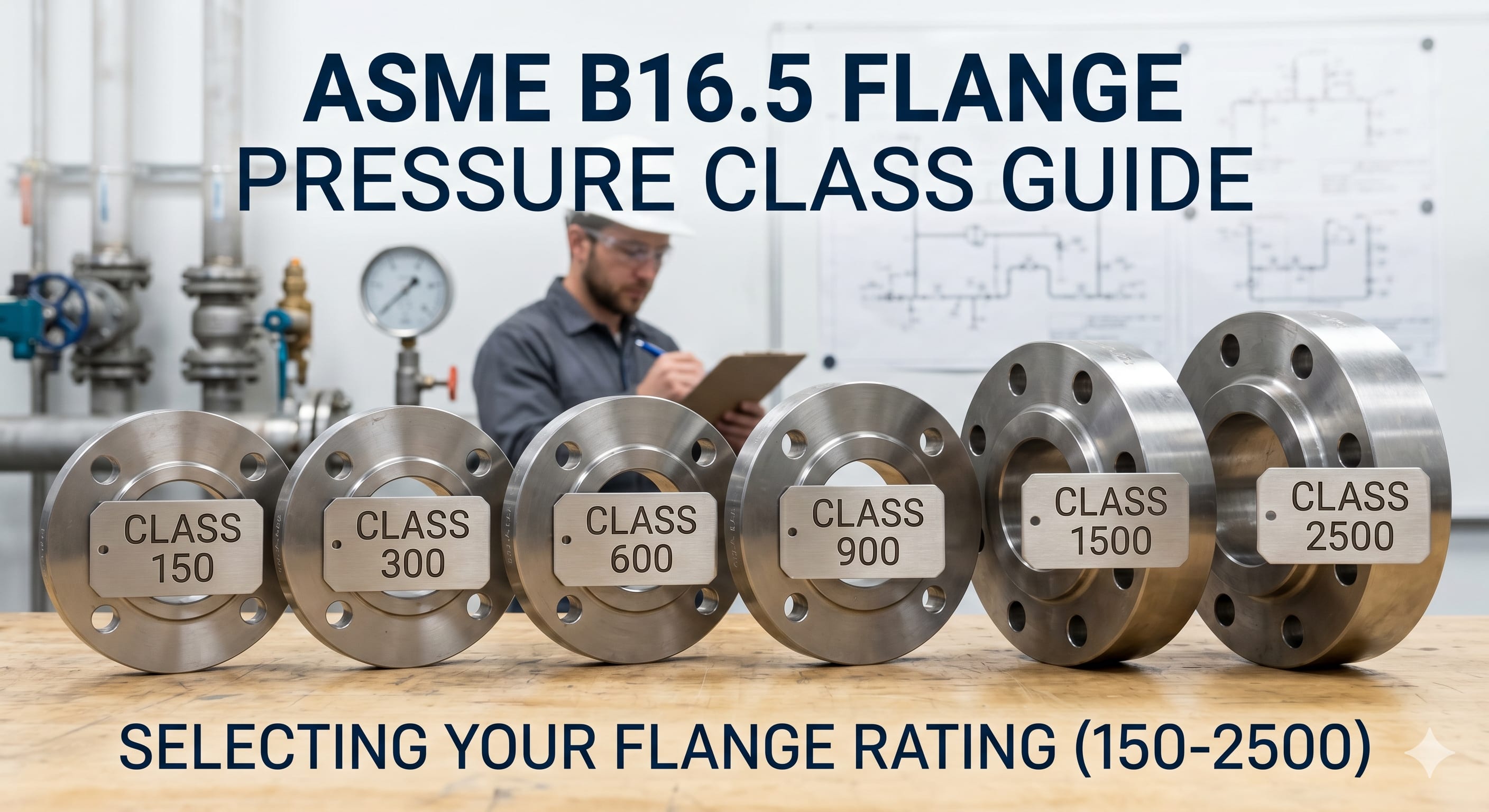
Class 150 — Class 300 — Class 400 — Class 600 — Class 900 — Class 1500 — Class 2500
Critical point that engineers frequently misunderstand: The class number is NOT a pressure value in psi or bar. Class 150 does NOT mean the flange is rated for 150 psi. The class number is a dimensionless designator that points to a pressure-temperature rating table. The actual allowable pressure depends on both the temperature AND the material group.
Class 150 Flanges
Class 150 is the lowest and most common pressure class. At ambient temperature (-29°C to 38°C), a Class 150 SS 316L flange (Material Group 2.2 per ASME B16.5) has an allowable working pressure of approximately 19.6 bar (285 psi).
As temperature rises, this drops significantly:
- At 100°C: ~17.7 bar
- At 200°C: ~15.1 bar
- At 300°C: ~13.2 bar
- At 400°C: ~12.1 bar
Typical applications: Low-pressure water lines, utility services, instrument air, cooling water, and atmospheric storage tank nozzles. Most water treatment plants and utility systems in India use Class 150.
Class 300 Flanges
Class 300 flanges are heavier, have more bolt holes, and handle significantly higher pressures than Class 150. At ambient temperature, a Class 300 SS 316L flange is rated at approximately 51.1 bar (741 psi) — nearly 2.5 times more than Class 150.
Note: Class 400 exists in ASME B16.5 but is rarely specified in modern projects. When in doubt, jump from Class 300 to Class 600.
Typical applications: Low-to-medium pressure process piping, steam systems below 200°C, chemical dosing lines, and general plant piping where Class 150 is marginal.
Class 600 Flanges
Class 600 represents the transition into high-pressure territory. At ambient temperature, a Class 600 SS 316L flange is rated at approximately 102.1 bar (1480 psi).
Typical applications: High-pressure steam systems, oil & gas process lines, reactor inlet/outlet connections, high-pressure chemical injection systems, and power plant main steam lines.
Class 900 Flanges
Class 900 is used for very high-pressure services. At ambient, a Class 900 SS 316L flange handles approximately 153.2 bar (2220 psi).
Typical applications: High-pressure oil & gas wellheads and manifolds, main steam lines in power boilers, high-pressure chemical reactors, and HP hydraulic systems.
Class 1500 and Class 2500 Flanges
These are the highest pressure classes in ASME B16.5. Class 1500 flanges handle approximately 255.3 bar (3700 psi) and Class 2500 approximately 425.5 bar (6170 psi) at ambient for SS 316L.
Note: Class 2500 is limited to NPS ½ through NPS 12 in ASME B16.5. Larger sizes require ASME B16.47.
Typical applications: Subsea equipment, HP gas compressor nozzles, ultra-high-pressure chemical reactors, and critical HPHT (High Pressure High Temperature) wellhead connections.
The Temperature De-Rating Effect — Never Ignore This
This is where most specification errors occur. Every material loses pressure-carrying capacity as temperature rises. The relationship is non-linear and material-specific.
Example: SS 316L Flanges, Class 150
| Temperature | Allowable Pressure |
|---|---|
| -29°C to 38°C | 19.6 bar (285 psi) |
| 100°C | 17.7 bar (257 psi) |
| 150°C | 15.8 bar (229 psi) |
| 200°C | 15.1 bar (219 psi) |
| 300°C | 13.2 bar (191 psi) |
| 400°C | 12.1 bar (176 psi) |
| 500°C | 10.2 bar (148 psi) |
A 250°C steam line at 14 bar pressure looks safe with Class 150 at first glance — the ambient rating is 19.6 bar. But at 250°C, the allowable pressure has dropped to approximately 14.4 bar, leaving almost zero safety margin. The correct specification would be Class 300.
ASME B16.5 Material Groups
ASME B16.5 divides flange materials into material groups. Each group has its own pressure-temperature table. The key groups relevant to Indian manufacturing:
- Group 1.1 — Carbon Steel (A105, A350 LF2) — highest pressure capacity at ambient
- Group 1.10 — Carbon Steel high yield (A694 F52, F60)
- Group 2.1 — SS 304, SS 304L — moderate capacity
- Group 2.2 — SS 316, SS 316L, SS 317, SS 321 — moderate capacity, better at temperature
- Group 2.3 — SS 347 — good high-temperature stability
- Group 3.1–3.4 — Nickel alloys, Inconel, Hastelloy — speciality high-temperature service
Important: Carbon steel A105 flanges carry significantly higher working pressure than SS 316L flanges of the same class at ambient temperature. This is why carbon steel flanges dominate in oil & gas where stainless is not required.
ASME B16.5 vs DIN/EN Flanges — Can You Mix Them?
Many Indian projects involve European clients or EPC contractors who specify DIN PN flanges. The ASME and DIN systems are NOT directly interchangeable, even though approximate equivalences exist:
| ASME Class | DIN PN Equivalent |
|---|---|
| Class 150 | PN 20 |
| Class 300 | PN 50 |
| Class 600 | PN 100 |
| Class 900 | PN 150 |
| Class 1500 | PN 250 |
| Class 2500 | PN 420 |
These are approximate equivalences only. Bolt hole patterns, face-to-face dimensions, and facing dimensions differ between ASME and DIN flanges. Never bolt an ASME B16.5 flange directly to a DIN EN 1092-1 flange without verifying dimensional compatibility and pressure-temperature ratings independently for each standard.
Angel Metal & Alloys manufactures flanges to both ASME B16.5 and DIN standards — clearly marked and certified separately. Specify which standard you need in your purchase order.
Step-by-Step Pressure Class Selection Method
Use this process for every new piping line:
Step 1 — Define the design conditions Get the maximum operating pressure (MOP) and maximum operating temperature (MOT) from the Process Datasheet or P&ID. Add the appropriate safety factor per your company piping specification (typically 10–15% above MOP).
Step 2 — Identify the fluid and material Determine the fluid being handled and select the appropriate material grade (see our SS 304 vs 316L guide). Identify the ASME B16.5 material group for your chosen grade.
Step 3 — Look up the pressure-temperature table In ASME B16.5 (purchase the latest edition from ASME at asme.org), find the P-T rating table for your material group. Start with Class 150 at your design temperature.
Step 4 — Check if Class 150 meets the requirement If the Class 150 allowable pressure at your design temperature exceeds your design pressure — you can use Class 150. Move to Step 6.
Step 5 — Step up the class until you find a fit If Class 150 is insufficient, check Class 300. If still insufficient, check Class 600, and so on. Select the lowest class that meets or exceeds the design pressure at the design temperature.
Step 6 — Check transient and upset conditions Do not only check steady-state. Steam-out conditions, thermal shock, pressure surges, and start-up/shutdown scenarios can briefly exceed steady-state pressure. Ensure the selected class handles these transients with margin.
Step 7 — Check NPS limitation Class 2500 is limited to NPS 12. For larger diameters at very high pressure, check ASME B16.47 Series A or Series B.
Common Errors in Flange Class Specification
Error 1 — Treating class as direct psi rating Class 150 ≠ 150 psi. Always use the P-T tables for your material group at design temperature.
Error 2 — Ignoring temperature de-rating The most dangerous error. Always check the P-T table at design temperature, not ambient.
Error 3 — Mixing Class 150 and Class 300 in the same piping system Both flanges will physically bolt together (same bolt pattern within some NPS ranges) but the Class 150 flange limits the system. Never mix classes without documenting the design basis.
Error 4 — Buying to ASME B16.5 but using DIN bolting ASME B16.5 bolt patterns require ASTM A193 B7 stud bolts with ASTM A194 2H heavy hex nuts for most classes. Using metric DIN bolts on ASME flanges is non-compliant and potentially unsafe.
Error 5 — Not verifying facing compatibility Raised Face (RF) is standard for Class 150 and above in most services. Ring Type Joint (RTJ) is required for Class 600 and above in oil & gas services per most company specifications. Check the project specification.
Quick Reference: Flange Class by Industry
| Industry / Service | Typical Class |
|---|---|
| Municipal water, utility air | Class 150 |
| Low pressure steam (< 10 bar) | Class 150 |
| General plant process piping | Class 150 or 300 |
| Medium pressure steam (10–50 bar) | Class 300 |
| Chemical reactor lines | Class 300 to 600 |
| High pressure steam (50–100 bar) | Class 600 |
| Oil & gas process lines | Class 300 to 900 |
| High pressure gas compressors | Class 900 to 1500 |
| HPHT wellheads, subsea | Class 1500 to 2500 |
| Boiler main steam (IBR) | Class 600 to 1500 |
Angel Metal & Alloys: Certified to ASME B16.5
Angel Metal & Alloys manufactures and stocks SS flanges in all seven ASME B16.5 pressure classes, in sizes ½" NB to 24" NB, in all material grades from SS 304 to Super Duplex 2507. Every flange is dispatched with:
- Mill Test Certificate (MTC) with full chemical and mechanical traceability
- Dimensional inspection report per ASME B16.5
- PMI (Positive Material Identification) report on request
- Hydrostatic test certificate on request
- IBR certification for steam service flanges (on request)
Our experienced team can review your line list or P&ID and recommend the correct class and grade for every line — at no charge.
Call us: +91 9974334455 | +91 9825003949 Email: angelmetalalloys@gmail.com Request Quote: angelmetalalloys.com/request-quote
Angel Metal & Alloys, B-917 Sun West Bank, Opp Rajasthan Hospital, Ahmedabad – 380013, Gujarat, India. Est. 2007. Exporting to 30+ countries.